←Back to Home EducationHOME EDUCATION · AGES 13–17 · 2027
Capability is built through real responsibility.
NAV is a six-month outdoor personal-development programme. Six field modules and an individual Personal Development Passport connect preparation, experience, reflection and increasing responsibility.Explore the journey ↓ProgrammeSix connected modules
Field time18 programme days
Age13–17
Complete programme£1,850
ABOUT THE AGE RANGE
Ages 13–17 is the general range, not the only measure of suitability.
Maturity, independence, individual needs and the make-up of the cohort also matter. Families can talk suitability through with us before applying.WHY THIS PROGRAMME EXISTS
Growing older happens naturally. Growing capable takes experience.
Young people do not become capable simply by being told what capability looks like.They need opportunities to prepare, decide, contribute, make mistakes, adapt and discover what they can genuinely do. Practical outdoor skills provide the vehicle; responsibility and reflection connect the experience.
THE COMPLETE PROGRAMME
Six modules. One progression.
The modules combine camp life, outdoor competence, navigation, first aid, teamwork, leadership and reflection. Navigation is one practical tool used to hand over responsibility; it is not the whole programme. The Personal Development Passport, preparation, readiness decisions and final expedition all sit inside the same journey.01Foundations · 19–21 May 2027Sussex Woodland
The group establishes camp, learns the routines it will use throughout the programme and begins sharing the work of living outdoors.
+
Practical work- Setting up and organising camp
- Personal kit, rucksacks, layers and waterproofs
- Fire lighting, fire management and stove use
- Basic map orientation
- Team tasks and camp responsibilities
Responsibility at this stageParticipants begin by managing their own kit, taking a camp job and learning when to ask for or offer help.
What it prepares them forA shared practical baseline for every later module.
02Navigation and teamwork · 15–17 June 2027Peak District
Navigation moves from something demonstrated by an instructor to short journey legs managed by the participants.
+
Practical work- Map orientation, contours and grid references
- Route planning and identifying useful features
- Compass bearings and back bearings
- Pacing, timings, pace and stops
- Communication while sharing navigation legs
Responsibility at this stageParticipants take responsibility for sections of the route, explain their decisions and check their progress against the ground.
What it prepares them forMore demanding personal navigation and relocation in woodland.
03Confidence through practice · 5–7 July 2027Ashdown Forest
Dense woodland makes navigation less obvious. Earlier skills are repeated through shorter, more precise legs with less instructor prompting.
+
Practical work- Micro-navigation through woodland
- Bearings, pacing and route timing
- Relocation when the route is no longer clear
- Outdoor first-aid scenarios
- Tracking and interpreting animal signs
Responsibility at this stageParticipants make their own navigation decisions, notice mistakes and work through recovery instead of immediately handing the problem back.
What it prepares them forMaking calm decisions when the environment provides fewer obvious answers.
04Judgement under uncertainty · 9–11 August 2027Dartmoor
Low-feature moorland tests whether navigation and group systems still work when landmarks are limited and conditions can change quickly.
+
Practical work- Longer navigation legs across open ground
- Relocation and checking assumptions
- Weather observation and route adjustment
- Hazards, escape routes and emergency planning
- Managing food, water, layers and timings
Responsibility at this stageThe group carries more of the route, forecast and movement plan, including what to do when progress or conditions differ from the plan.
What it prepares them forSustained responsibility and leadership in mountain terrain.
05Leadership in complex terrain · 20–22 September 2027Lake District
Longer mountain journeys bring navigation, weather, pace, fatigue and group welfare together. Leadership is judged by what the group needs, not who speaks most.
+
Practical work- Mountain route planning and terrain choices
- Navigation through larger contour features
- Weather, layers and changing conditions
- Pace, fatigue, stops and group welfare
- Emergency shelter and response planning
Responsibility at this stageLeadership rotates. Participants plan, brief, navigate, monitor the group and hand responsibility over clearly rather than trying to control every task.
What it prepares them forThe readiness decision for the participant-led expedition.
06Participant-led expedition · 5–7 October 2027Final expedition
Participants bring the programme together by planning, preparing and completing an expedition as a working group.
+
Practical work- Route, forecast, equipment and timings
- Navigation legs, pace and planned stops
- Food, water, layers and fatigue
- Communication and off-route decisions
- Camp systems, recovery and the journey out
Responsibility at this stageThe young people organise the expedition and respond to what happens. Instructors retain safety oversight without taking back work the group is ready to carry.
What it prepares them forA clear demonstration of what each participant and the group can now do reliably.
HOW DEVELOPMENT HAPPENS
Skills and responsibility develop together.
Learn
Meet the skill, understand why it matters and try it with support.
Practise
Repeat it in real conditions until it becomes dependable.
Take responsibility
Own preparation, equipment and a meaningful part of the shared work.
Make decisions
Choose, adapt and deal with the consequences rather than waiting for an adult to organise everything.
Reflect
Use the Passport and group review to understand what happened and what needs more work.
Demonstrate capability
Show reliable judgement and contribution before greater responsibility is handed over.
BETWEEN MODULES
The Personal Development Passport.
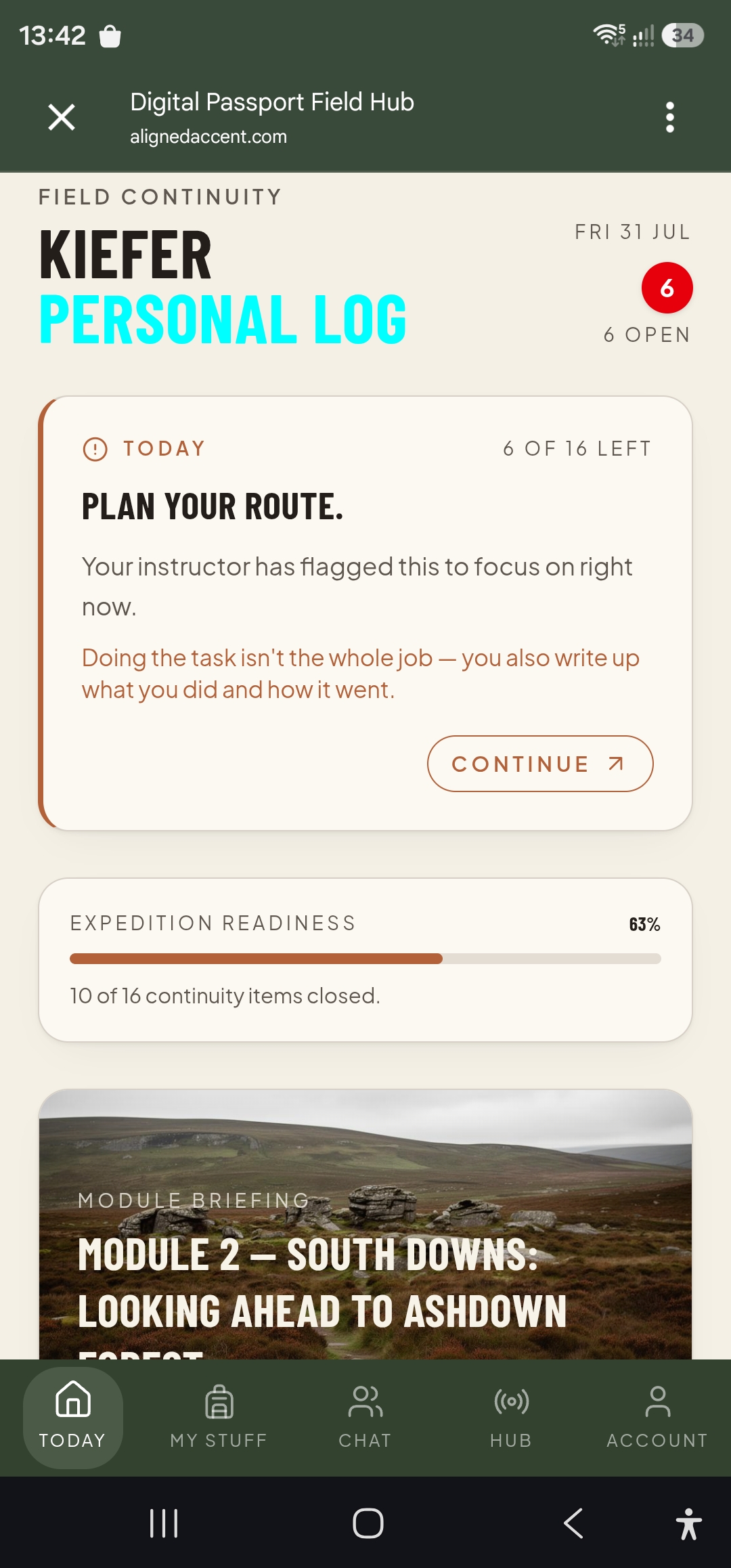
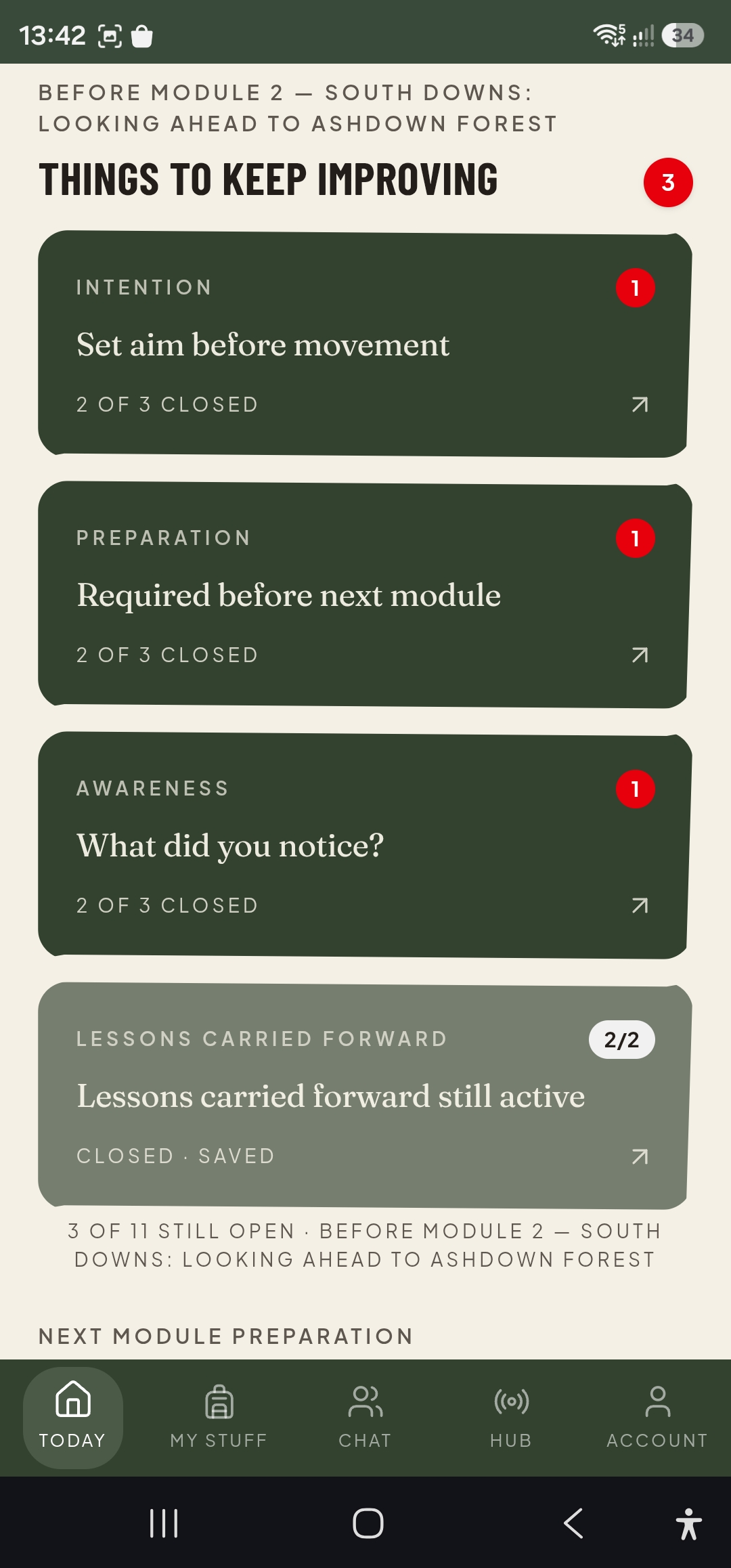
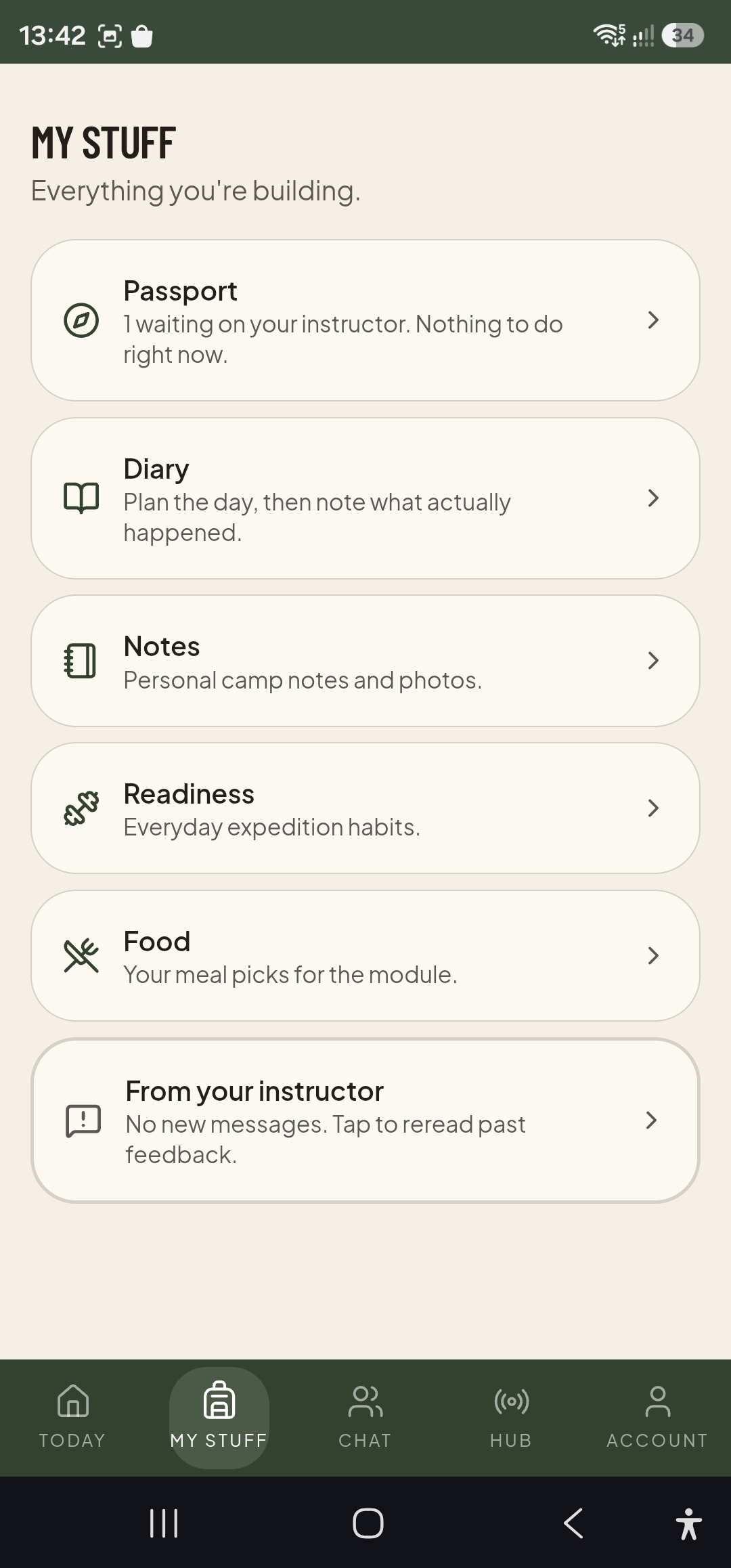
The programme continues after participants leave the field.Each young person has their own digital Passport for preparation, reflection, challenges, equipment, instructor feedback and evidence of progress. It connects one module to the next and helps us decide what support, practice or responsibility should come next. Parents can follow the journey without taking ownership away from the participant.- What happened · why · what was learned · what comes next
- Preparation and equipment before each module
- Challenges and readiness work between field weekends
- Instructor feedback and progress across the programme
WHAT THE PRICE COVERS
£1,850 for the complete six-module programme.
18 programme days · approximately £103 per programme day- Six three-day field modules
- Instruction and safety oversight
- Personal Development Passport access
- Programme planning and progression
- Participant-led final expedition, subject to readiness
COMMITMENT
Preparation matters.
- £300 deposit after acceptance
- Families arrange travel to each location
- Required Passport work between modules
- Consistent engagement across the journey
- Final expedition readiness is assessed, not assumed
APPLICATIONS FOR 2027
Apply or talk it through first.
Applying does not commit you to payment. It gives us enough information to discuss suitability, support needs and the expectations of the complete programme.